Presbyopia

Learn More

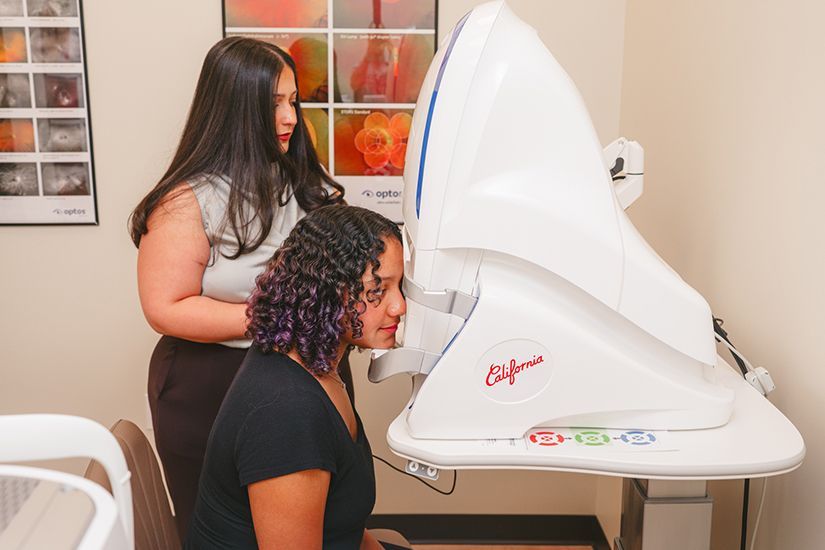
At Luxe Eye and Wellness, we use advanced digital retinal imaging to evaluate the health of your eyes without the need for traditional dilation drops. Our optometry office in Old Town Alexandria offers Optomap wide angle retinal imaging, which captures a detailed view of the retina in seconds. This technology allows our doctors to screen for retinal conditions such as diabetic retinopathy, macular degeneration, and retinal tears while minimizing discomfort and avoiding the side effects of dilation. The imaging process lets patients see the back of their eyes just as the doctor does and is safe for children, adults, and pregnant patients seeking comprehensive eye exams in Alexandria VA.
Person wearing a gray VR headset and black jacket against a plain background

What to Expect

The IPL technology targets pigmentation and vascular issues, improving skin tone and texture. The controlled heat stimulates collagen production while the body naturally removes treated tissue, enhancing overall skin appearance. The procedure typically lasts 15-30 minutes and is well-tolerated with minimal discomfort.

The treatment targets imperfections and stimulates collagen production over multiple sessions. Results for light pigmentation and sun spots can appear in 1-2 treatments, while most concerns may need 2-6 sessions, spaced 2-4 weeks apart.

Varieties of AMD

Glaucoma is a disease that damages your eye’s optic nerve. Most commonly, this occurs when fluid builds up in the front part of your eye which increases the pressure in your eye, damaging the optic nerve. There are four types of glaucoma: open-angle, normal tension, angle-closure, and secondary.

Manual refraction with a phoropter.

This test is used to estimate which lens powers will best correct distance vision. Based on the way the light reflects from the eye, the doctor is able to obtain an approximation of the eyeglass prescription. This test is useful for children and patients who are unable to accurately answer the doctor's questions.


Concerned woman in pink sweater looking at her phone on a couch

Presbyopia is a natural and inevitable part of aging that affects the eyes' ability to focus on close objects. Unlike other vision conditions, presbyopia isn’t caused by the shape of the eye or structural abnormalities but is instead a result of the eye’s lens losing its flexibility over time.

What is Presbyopia?

Presbyopia is a refractive error, meaning it affects how the eyes bend (or refract) light to focus it on the retina. Unlike nearsightedness (myopia) or farsightedness (hyperopia), which are caused by the shape of the eyeball or cornea, presbyopia is due to the aging of the eye's lens. Over time, the lens becomes less flexible, making it difficult to focus on nearby objects. Presbyopia isn’t a disease or an abnormality—it’s simply a natural consequence of the aging process.

What Causes Presbyopia?

The lens inside the eye changes shape to focus light on the retina, allowing us to see clearly at varying distances. When viewing nearby objects, the lens thickens and curves to increase its refractive power.


As we age, however:

  • Lens Stiffening: The lens loses elasticity, making it harder to bend and adjust for near vision.
  • Weakened Ciliary Muscles: The muscles that help change the shape of the lens may lose their strength over time, further reducing the eye’s ability to focus on close objects.
  • Structural Changes: The lens also grows thicker and less transparent with age, which contributes to reduced focusing ability.


These changes are gradual, typically starting in a person’s 30s and becoming noticeable by their early to mid-40s.

Older man touching his face with one hand, standing against a plain white background.

Common Symptoms of Presbyopia

The symptoms of presbyopia often develop gradually and may include:

  • Difficulty Reading Small Print: People may find themselves holding reading materials at arm’s length to see clearly.
  • Eye Strain: Extended periods of close work, like reading or using a computer, can cause discomfort.
  • Headaches: Frequent headaches can occur due to the added strain on the eyes.
  • Blurry Vision: Near objects may appear blurry, especially in dim lighting.
  • Fatigue: Eyes may feel tired or strained after close-up tasks.

How is Presbyopia Diagnosed?

Presbyopia is typically diagnosed during a comprehensive eye exam conducted by an eye care professional. The evaluation may include tests to assess the ability to focus on nearby objects and measurements of visual acuity at various distances. Additionally, the eye care professional will discuss any symptoms you are experiencing and how they impact your daily activities, allowing for a thorough understanding of your condition and the development of a personalized treatment plan.

Treatment Options for Presbyopia

There are several effective treatments for presbyopia, tailored to suit different lifestyles and vision needs.


Eyeglasses:

  • Reading Glasses: Single-vision lenses designed specifically for close-up tasks.
  • Bifocals: Lenses with two sections, one for distance vision and one for near vision.
  • Progressive Lenses: Multifocal lenses that provide a gradual transition between near, intermediate, and distance vision.


Contact Lenses:

  • Multifocal Contacts: These lenses have different zones for near, intermediate, and distance vision.


Surgical Options:

  • Refractive Lens Exchange (RLE): Replacing the eye’s natural lens with an artificial intraocular lens (IOL).
  • Monovision LASIK: Corrects one eye for near vision and the other for distance.
  • Corneal Inlays: A small device is implanted in the cornea to improve near vision.

Managing Presbyopia

While presbyopia cannot be prevented, its effects can be managed effectively with regular eye exams and personalized vision care. Early diagnosis and treatment not only improve quality of life but also help detect other age-related eye conditions, such as cataracts or macular degeneration.


If you're experiencing signs of presbyopia or want to explore the latest treatment options, schedule a comprehensive eye exam with us today!

Helpful Articles