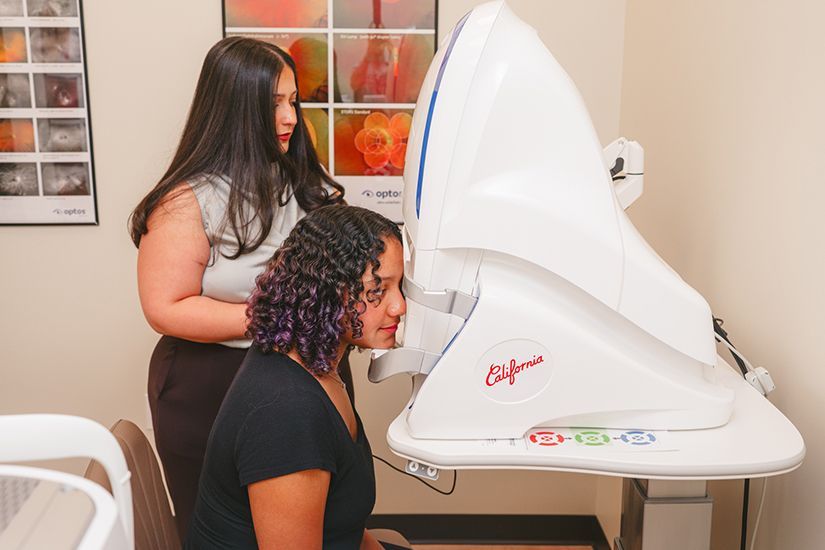
At Luxe Eye and Wellness, we use advanced digital retinal imaging to evaluate the health of your eyes without the need for traditional dilation drops. Our optometry office in Old Town Alexandria offers Optomap wide angle retinal imaging, which captures a detailed view of the retina in seconds. This technology allows our doctors to screen for retinal conditions such as diabetic retinopathy, macular degeneration, and retinal tears while minimizing discomfort and avoiding the side effects of dilation. The imaging process lets patients see the back of their eyes just as the doctor does and is safe for children, adults, and pregnant patients seeking comprehensive eye exams in Alexandria VA.
What to Expect
The IPL technology targets pigmentation and vascular issues, improving skin tone and texture. The controlled heat stimulates collagen production while the body naturally removes treated tissue, enhancing overall skin appearance. The procedure typically lasts 15-30 minutes and is well-tolerated with minimal discomfort.
The treatment targets imperfections and stimulates collagen production over multiple sessions. Results for light pigmentation and sun spots can appear in 1-2 treatments, while most concerns may need 2-6 sessions, spaced 2-4 weeks apart.
Varieties of AMD
Glaucoma is a disease that damages your eye’s optic nerve. Most commonly, this occurs when fluid builds up in the front part of your eye which increases the pressure in your eye, damaging the optic nerve. There are four types of glaucoma: open-angle, normal tension, angle-closure, and secondary.
Manual refraction with a phoropter.
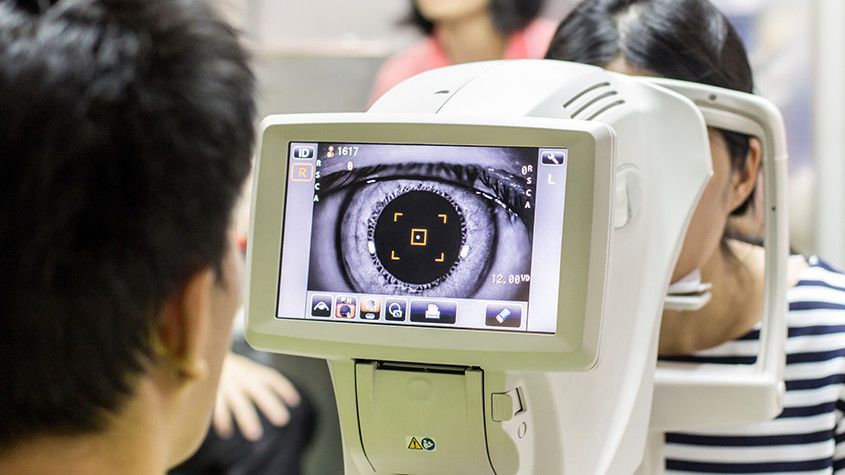
This test is used to estimate which lens powers will best correct distance vision. Based on the way the light reflects from the eye, the doctor is able to obtain an approximation of the eyeglass prescription. This test is useful for children and patients who are unable to accurately answer the doctor's questions.
There are several effective treatments for presbyopia, tailored to suit different lifestyles and vision needs.
Eyeglasses:
- Reading Glasses: Single-vision lenses designed specifically for close-up tasks.
- Bifocals: Lenses with two sections, one for distance vision and one for near vision.
- Progressive Lenses: Multifocal lenses that provide a gradual transition between near, intermediate, and distance vision.
Contact Lenses:
- Multifocal Contacts: These lenses have different zones for near, intermediate, and distance vision.
Surgical Options:
- Refractive Lens Exchange (RLE): Replacing the eye’s natural lens with an artificial intraocular lens (IOL).
- Monovision LASIK: Corrects one eye for near vision and the other for distance.
- Corneal Inlays: A small device is implanted in the cornea to improve near vision.
While presbyopia cannot be prevented, its effects can be managed effectively with regular eye exams and personalized vision care. Early diagnosis and treatment not only improve quality of life but also help detect other age-related eye conditions, such as cataracts or macular degeneration.
If you're experiencing signs of presbyopia or want to explore the latest treatment options, schedule a comprehensive eye exam with us today!

All Eyecare Services
We offer a wide variety of eye care services to the Alexandria community. Contact us with any questions about our services.

Keep In Touch
For non-urgent questions or to learn more about our services, contact us today!