How Your Eyes Change with Age

Learn More

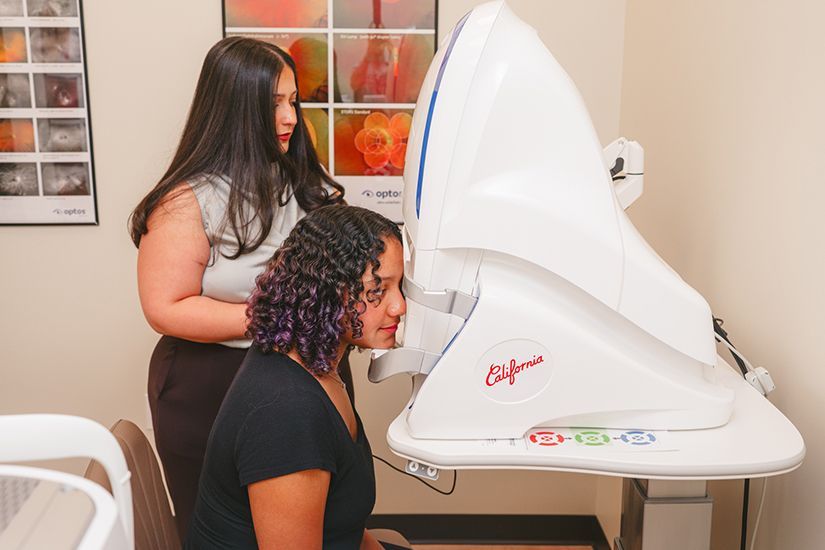
At Luxe Eye and Wellness, we use advanced digital retinal imaging to evaluate the health of your eyes without the need for traditional dilation drops. Our optometry office in Old Town Alexandria offers Optomap wide angle retinal imaging, which captures a detailed view of the retina in seconds. This technology allows our doctors to screen for retinal conditions such as diabetic retinopathy, macular degeneration, and retinal tears while minimizing discomfort and avoiding the side effects of dilation. The imaging process lets patients see the back of their eyes just as the doctor does and is safe for children, adults, and pregnant patients seeking comprehensive eye exams in Alexandria VA.
Person wearing a gray VR headset and black jacket against a plain background

What to Expect

The IPL technology targets pigmentation and vascular issues, improving skin tone and texture. The controlled heat stimulates collagen production while the body naturally removes treated tissue, enhancing overall skin appearance. The procedure typically lasts 15-30 minutes and is well-tolerated with minimal discomfort.

The treatment targets imperfections and stimulates collagen production over multiple sessions. Results for light pigmentation and sun spots can appear in 1-2 treatments, while most concerns may need 2-6 sessions, spaced 2-4 weeks apart.

Experience Relief with Avulux Lenses

Smiling older couple sitting together on a couch, looking at a laptop

As our bodies age, it is normal to notice that there are decreases in our ability to complete certain functions that may have been natural for us in our youth. Just like our physical strength, the strength of your eyes can also weaken over time.

Several different factors influence how each of us will experience aging. Your genetics can play a pivotal role. Understanding your family history and making sure to communicate this with your health professional can be a great way to monitor changes and spot early signs and symptoms. Exposure to certain chemicals or environments or specific trauma to our eyes can also have an impact on how our eyes age. While the eyes can often recover from traumatic injury or exposure, they may still have a detrimental effect on your vision as you age.

Knowing what age you start to have an increased risk of certain diseases or eye conditions can help you to be prepared when you meet with your
optometrist. Here are some of the most common ailments that people experience when they age.

Presbyopia

Once you are over 40 years old you may experience a loss in vision at close range. Presbyopia is a normal condition that occurs due to the hardening of the lens in your eye. In the early stages, you can often compensate for small changes to your vision, but as the condition progresses, you will likely need a corrective lens, or choose a surgical procedure. such as Lasik, corneal inlays, refractive lens exchange, and conductive keratoplasty.

Cataracts

Cataracts are technically a disease of the eye. However, they are so frequently seen in patients as they age, that they are classified as a normal part of aging. While almost half of the population over 65 have cataracts, that number increases even more by age 70. While it can be frightening to begin losing your vision, cataract surgery is extremely successful and can restore up to 100% of the lost vision. If you notice even small changes to your vision, it is smart to talk to your doctor. Cataract surgery is best performed when the cataracts are small and can be more easily removed.

Macular Degeneration

Macular Degeneration is the leading cause of blindness in senior citizens in the United States.

Glaucoma

The risk of developing glaucoma generally begins when you are in your 40’s with a near one percent chance and increases throughout the decades with a twelve percent by the time you are in your 80’s.

Diabetic Retinopathy

Individuals who have diabetes may be affected by diabetic retinopathy. This disease occurs when blood sugar levels are elevated for an extended period that causes damage to the eye. This damage may lead to permanent vision loss. Americans with diabetes over the age of 40 are at an increased risk, with about 40 percent of people with diabetes over this age displaying some degree of diabetic retinopathy.

Helpful Articles